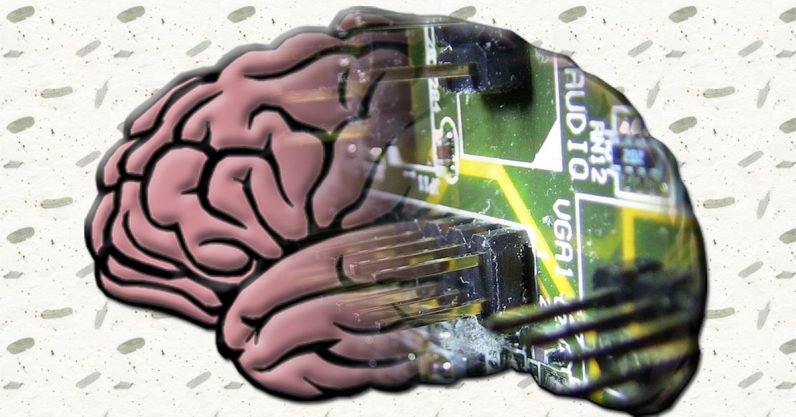
New MIT brain research shows how AI could help us understand consciousness


A team of researchers from MIT and Massachusetts General Hospital recently published a study linking social awareness to individual neuronal activity. To the best of our knowledge, this is the first time evidence for the ‘theory of mind‘ has been identified at this scale. Measuring large groups of neurons is the bread-and-butter of neurology. Even a simple MRI can highlight specific regions of the brain and give scientists an indication of what they’re used for and, in many cases, what kind of thoughts are happening. But figuring out what’s going on at the single-neuron level is an entirely different feat.…

This story continues at The Next Web

from The Next Web https://ift.tt/3op8xvx

Comments

Popular posts from this blog

TNW Podcast: Oscar Kneppers on academic startups; ESA wants to detect space-time ripples

Welcome to the new episode of the TNW Podcast — the show where we discuss the latest developments in the European technology ecosystem and feature interviews with some of the most interesting people in the industry. In today’s episode, Andrii and Linnea talk about a new European space mission, AI-generated podcasts, antiquated tech in German trains, and much more. In the interview section, we’re featuring a conversation with Oscar Kneppers, CEO of the Amsterdam Centre for Entrepreneurship, or ACE. He’s also founded several well-known local publications and one of the country’s major startup accelerators, Rockstart. Here are the stories and… This story continues at The Next Web from The Next Web https://ift.tt/a6AlDsr

Swiss startup believes this forgotten element is the key to safe nuclear energy

Nuclear energy is undergoing a renaissance. Across Europe, governments are pouring huge amounts of money into new power plants while startups are busily working on smaller, modular alternatives.  Most of these plants rely on uranium, the radioactive metal that fuelled the atomic age (and contributed to a couple of catastrophic meltdowns). However, Swiss startup Transmutex wants to reinvent nuclear energy using a lesser-known element called thorium.  Uranium’s forgotten cousin Thorium is a lead-like metal that is mildly reactive, but four times more abundant than uranium and a lot safer to handle. However, thorium is a fissionable material but not a… This story continues at The Next Web from The Next Web https://ift.tt/ideQqVM

Cyberflashing and epilepsy-trolling offenders to face prison in UK

As of today, the UK is criminalising actions such as cyberflashing and — in a world fist — epilepsy-trolling, with offenders potentially facing prison time. The new offences will come into play as part of the Online Safety Act, a recently introduced bill designed to protect people from illegal or “harmful” online content. Cyberflashing is the act of sending unwanted sexual photos. Studies have shown that about half of younger women (aged between 18 and 25) have received unsolicited nude images. The percentage is even higher for females under 18, reaching 76%, according to a 2020 research. Now, cyberflashing offenders… This story continues at The Next Web from The Next Web https://ift.tt/9EZvymL