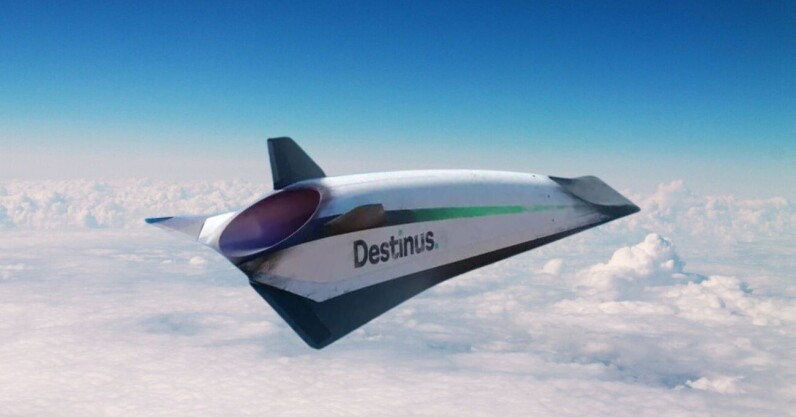
This hypersonic hydrogen jet could fly from London to New York in 90 mins


Flying across the world from Europe to Australia currently takes around 20 hours in a regular passenger jet. But Swiss startup Destinus is looking to slash that time to just four hours — by taking jet travel to hypersonic speeds.  Founded by Russian-born physicist and serial entrepreneur Mikhail Kokorich, Destinus is developing a prototype hydrogen-powered aircraft capable of travelling at Mach 5 and above. That’s five times the speed of sound: over 6000 kph.  This would take you from Frankfurt to Sydney in just over four hours. London to New York? 90 minutes.   To achieve such speeds the aircraft would…

This story continues at The Next Web

from The Next Web https://ift.tt/E7UhlHJ

Comments

Popular posts from this blog

TNW Podcast: Boris comes over to co-host; Slack’s Cal Henderson talks European tech

 Welcome to the new episode of the TNW Podcast — the show where we discuss the latest developments in the European technology ecosystem and feature interviews with some of the most interesting people in the industry. In today’s episode, Andrii is joined by Boris Veldhuijzen van Zanten, co-founder, member of the board, and former CEO of TNW. The topics discussed include the jobs created by Dutch startups, giant state funding for energy projects, translations of the word ‘computer’, and a bunch of other things in between. In the interview section, we’re featuring a conversation with Cal Henderson, co-founder and… This story continues at The Next Web from The Next Web https://ift.tt/jUgcNFD

2024’s most important travel tech trends

Guest post by Singapore Tourism Board As the tourism industry continues its post-pandemic recovery in an increasingly uncertain travel market, a question that has dawned upon us is — what’s next? Naturally, many of us are looking towards technology for more opportunities. In 2023, we saw the generative AI boom and further growth of emerging technologies like extended reality (XR) and 5G. While these advances are already shaping the travel sector, there is much more to come as more use cases emerge while the technology further matures. Looking forward into 2024, we can expect teams to do more with less, streamline their… This story continues at The Next Web from The Next Web https://ift.tt/seCScOH

Why is Venus so inhospitable? ESA launches new mission to find out

The European Space Agency (ESA) has embarked on a new mission to explore our closest planetary neighbour Venus in unprecedented detail.  Known as EnVision, the spacecraft will study Venus from the planet’s inner core to its outer atmosphere, to help astronomers understand why the scorching, toxic world is so different from Earth.  Work will begin on the spacecraft and its instruments later this year, following the selection of an industrial contractor. EnVision is set to launch on board an Ariane 6 rocket from Europe’s spaceport in French Guiana in 2031.  “EnVision will answer longstanding open questions about Venus, arguably the… This story continues at The Next Web from The Next Web https://ift.tt/anZTFDP