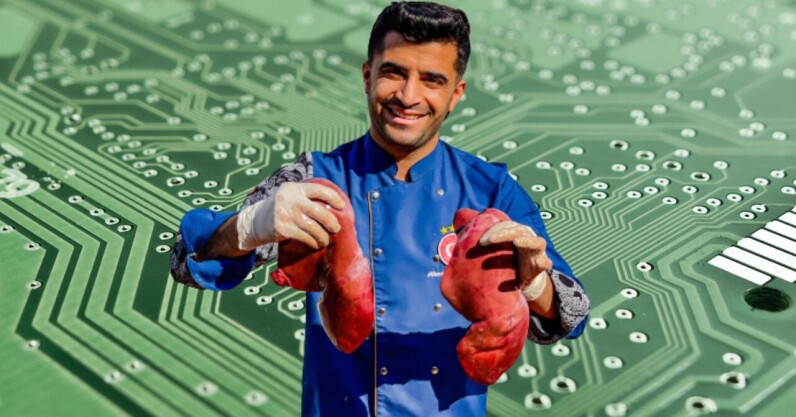
3D-printed organs could solve liver transplant shortage, startup says


You can already buy 3D-printed houses, cars, rocket engines, sneakers, and, of course, sex robots. But can I interest you in a 3D-printed kidney? It’s an offer that Vital3D plans to make a reality. The Lithuanian startup is among a growing wave of companies that want to “bioprint” body parts. Approaches to the task are varied.  In the Vital3D system, lasers precisely deposit living cells and biomaterials in 3D patterns. The company says this creates functional, scalable, and reproducible tissue constructs. Vital3D believes the tech can bridge the gap between organ demand and supply. It’s a gulf that’s widening each…

This story continues at The Next Web

from The Next Web https://ift.tt/QS9f3Pl

Comments

Popular posts from this blog

TNW Podcast: Oscar Kneppers on academic startups; ESA wants to detect space-time ripples

Welcome to the new episode of the TNW Podcast — the show where we discuss the latest developments in the European technology ecosystem and feature interviews with some of the most interesting people in the industry. In today’s episode, Andrii and Linnea talk about a new European space mission, AI-generated podcasts, antiquated tech in German trains, and much more. In the interview section, we’re featuring a conversation with Oscar Kneppers, CEO of the Amsterdam Centre for Entrepreneurship, or ACE. He’s also founded several well-known local publications and one of the country’s major startup accelerators, Rockstart. Here are the stories and… This story continues at The Next Web from The Next Web https://ift.tt/a6AlDsr

Swiss startup believes this forgotten element is the key to safe nuclear energy

Nuclear energy is undergoing a renaissance. Across Europe, governments are pouring huge amounts of money into new power plants while startups are busily working on smaller, modular alternatives.  Most of these plants rely on uranium, the radioactive metal that fuelled the atomic age (and contributed to a couple of catastrophic meltdowns). However, Swiss startup Transmutex wants to reinvent nuclear energy using a lesser-known element called thorium.  Uranium’s forgotten cousin Thorium is a lead-like metal that is mildly reactive, but four times more abundant than uranium and a lot safer to handle. However, thorium is a fissionable material but not a… This story continues at The Next Web from The Next Web https://ift.tt/ideQqVM

Insta mules and crypto mixers: How tech is transforming money laundering

On the shallow surface of Instagram, Ramon “Hushpuppi” Abbas was a quintessential influencer. The flamboyant Nigerian portrayed a lavish lifestyle of private jets, luxury cars, and designer clothes. His glamorous adventures had earned him over 2 million followers and millions of dollars. But his posts concealed a darker reality. The 41-year-old was “one of the most prolific money launderers in the world,” according to the FBI. By his own admission, Hushpuppi conspired to launder over $300mn in just 18 months. One of his alleged clients was a certain Kim Jong Un — the supreme leader of North Korea. With his… This story continues at The Next Web from The Next Web https://ift.tt/rd549ui