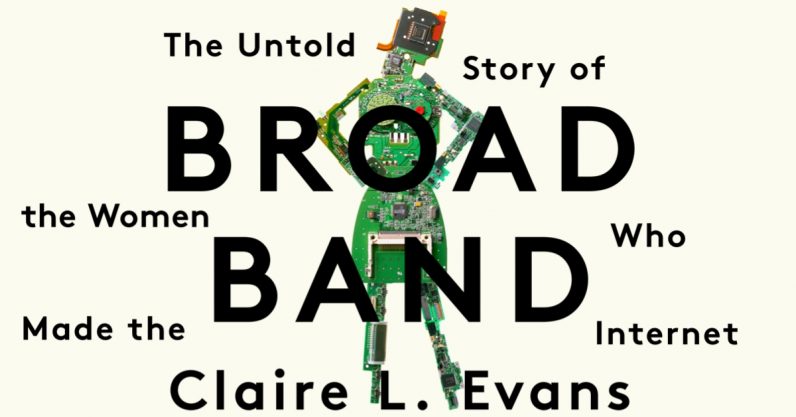
‘Broad Band’ is the best book we’ve read on women in computing


To those unfamiliar with computing history, the world’s first general-purpose computer was the ENIAC (Electronic Numerical Integrator and Computer). Made public in 1946, this 30-ton “giant brain” had a military purpose — it was created to help the US Army calculate artillery fire. The ENIAC was operated by six programmers — Kay McNulty, Betty Jennings, Betty Snyder, Marlyn Meltzer, Fran Bilas, and Ruth Lichterman. Handpicked from University of Pennsylvania’s engineering school, these six women were the first “computers” — and were subsequently left out of the celebration over the magical self-computing “giant brain.” And they were hardly an anomaly —…

This story continues at The Next Web

from The Next Web https://ift.tt/2usP97g

Comments

Popular posts from this blog

TNW Podcast: Oscar Kneppers on academic startups; ESA wants to detect space-time ripples

Welcome to the new episode of the TNW Podcast — the show where we discuss the latest developments in the European technology ecosystem and feature interviews with some of the most interesting people in the industry. In today’s episode, Andrii and Linnea talk about a new European space mission, AI-generated podcasts, antiquated tech in German trains, and much more. In the interview section, we’re featuring a conversation with Oscar Kneppers, CEO of the Amsterdam Centre for Entrepreneurship, or ACE. He’s also founded several well-known local publications and one of the country’s major startup accelerators, Rockstart. Here are the stories and… This story continues at The Next Web from The Next Web https://ift.tt/a6AlDsr

Swiss startup believes this forgotten element is the key to safe nuclear energy

Nuclear energy is undergoing a renaissance. Across Europe, governments are pouring huge amounts of money into new power plants while startups are busily working on smaller, modular alternatives.  Most of these plants rely on uranium, the radioactive metal that fuelled the atomic age (and contributed to a couple of catastrophic meltdowns). However, Swiss startup Transmutex wants to reinvent nuclear energy using a lesser-known element called thorium.  Uranium’s forgotten cousin Thorium is a lead-like metal that is mildly reactive, but four times more abundant than uranium and a lot safer to handle. However, thorium is a fissionable material but not a… This story continues at The Next Web from The Next Web https://ift.tt/ideQqVM

Insta mules and crypto mixers: How tech is transforming money laundering

On the shallow surface of Instagram, Ramon “Hushpuppi” Abbas was a quintessential influencer. The flamboyant Nigerian portrayed a lavish lifestyle of private jets, luxury cars, and designer clothes. His glamorous adventures had earned him over 2 million followers and millions of dollars. But his posts concealed a darker reality. The 41-year-old was “one of the most prolific money launderers in the world,” according to the FBI. By his own admission, Hushpuppi conspired to launder over $300mn in just 18 months. One of his alleged clients was a certain Kim Jong Un — the supreme leader of North Korea. With his… This story continues at The Next Web from The Next Web https://ift.tt/rd549ui